NASA-JAXA XRISM Mission Sees Pulsar Gathering Companion’s ‘Wind’
First reported Fri, 18 Sep 2026 18:02:53 GMT · Last updated
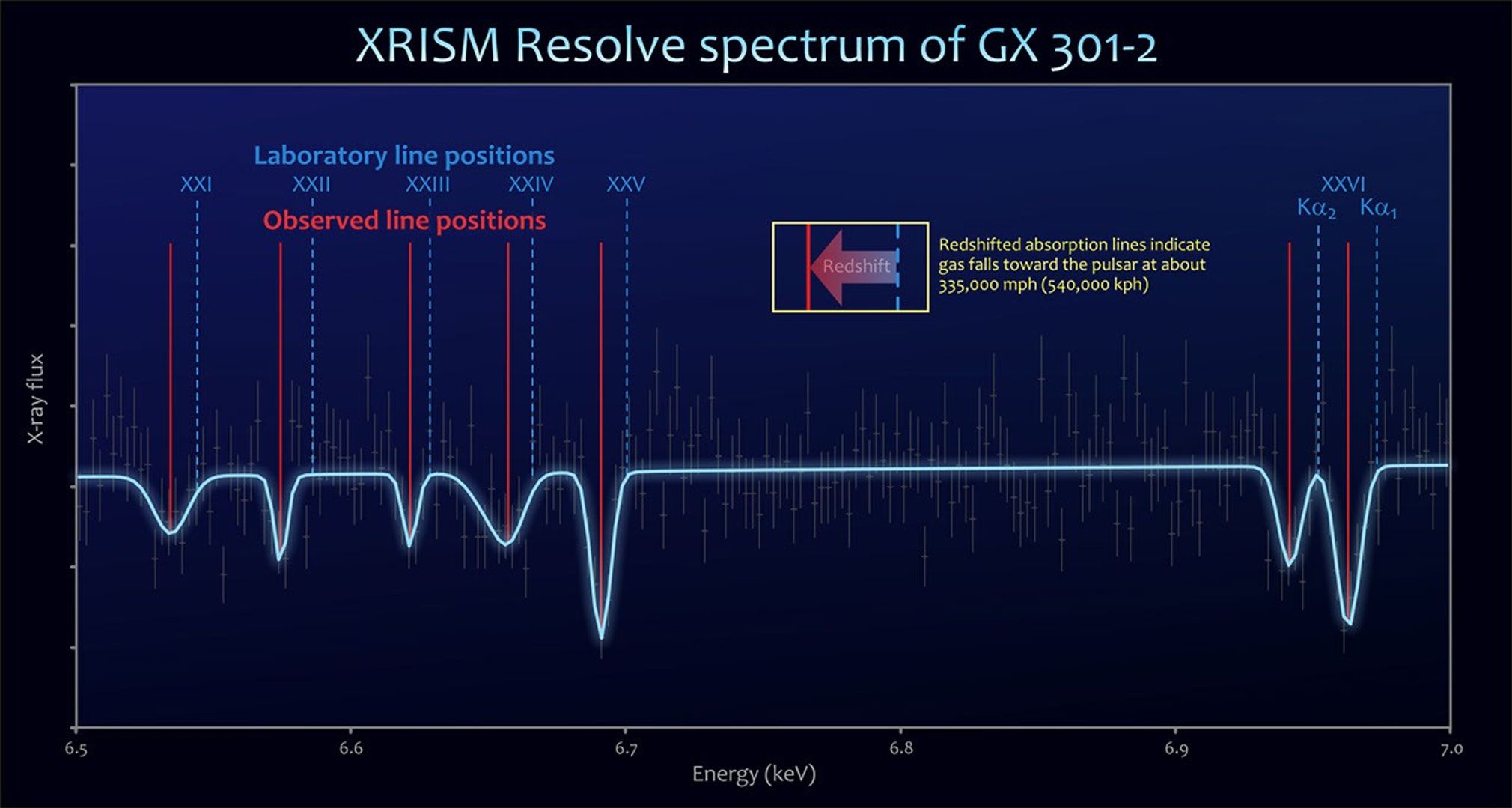
5 min read NASA-JAXA XRISM Mission Sees Pulsar Gathering Companion’s ‘Wind’ Using data from the Japan-led XRISM (X-ray Imaging and Spectroscopy Mission) observatory, astronomers have directly observed a giant star’s outflow, called a stellar wind, being captured by its compact companion and providing the power source for strong X-ray flares. The research is part of NASA’s exploration of the extreme universe to better understand how the cosmos works. “We’ve never before seen clear indications of wind plasma falling onto a compact object,” said Roi Rahin, a researcher at UMBC (University of Maryland, Baltimore County) and NASA’s Goddard Space Flight Center in Greenbelt, Maryland. “We can now test our understanding of these processes in much greater detail.” A paper describing the findings published Friday in the journal Science Advances. The target system is BP Crucis, a high-mass X-ray binary located about 13,000 light-years away in the southern constellation Crux. The primary star, known as Wray 977, is a blue hypergiant about 40 times the Sun’s mass and 60 times its size. It’s so big, hot, and luminous that ionized gas constantly streams away from it, a phenomenon astronomers call
1 source in this cluster
- NASANASA-JAXA XRISM Mission Sees Pulsar Gathering Companion’s ‘Wind’
5 min read NASA-JAXA XRISM Mission Sees Pulsar Gathering Companion’s ‘Wind’ Using data from the Japan-led XRISM (X-ray Imaging and Spectroscopy Mission) observatory, astronomers have directly observed a giant star’s outflow, called a stellar wind, being captured by its compact companion and providing the power source for strong X-ray flares. The research is part of NASA’s exploration of the extreme universe to better understand how the cosmos works. “We’ve never before seen clear indications of wind plasma falling onto a compact object,” said Roi Rahin, a researcher at UMBC (University of Maryland, Baltimore County) and NASA’s Goddard Space Flight Center in Greenbelt, Maryland. “We can now test our understanding of these processes in much greater detail.” A paper describing the findings published Friday in the journal Science Advances. The target system is BP Crucis, a high-mass X-ray binary located about 13,000 light-years away in the southern constellation Crux. The primary star, known as Wray 977, is a blue hypergiant about 40 times the Sun’s mass and 60 times its size. It’s so big, hot, and luminous that ionized gas constantly streams away from it, a phenomenon astronomers call
Fri, 18 Sep 2026 18:02:53 GMT
Timeline
- 2026-09-18 18:02NASA — NASA-JAXA XRISM Mission Sees Pulsar Gathering Companion’s ‘Wind’
How to read this page
- Headlines, quotes and facts come from the linked original articles (reporting).
- "Newsei analysis" and "Why it matters" are AI-assisted synthesis (inference).
- "Confirmed" means two or more independent outlets reported the same claim.
Methodology · Source profiles & bias labels · Corrections policy · Report an error: info@newsei.com
Share this timeline
Embed shows this story's live timeline on your own site and links back here.